Skip to main content

The Africa Forward Summit 2026: Does it present a new investment architecture for the continent?
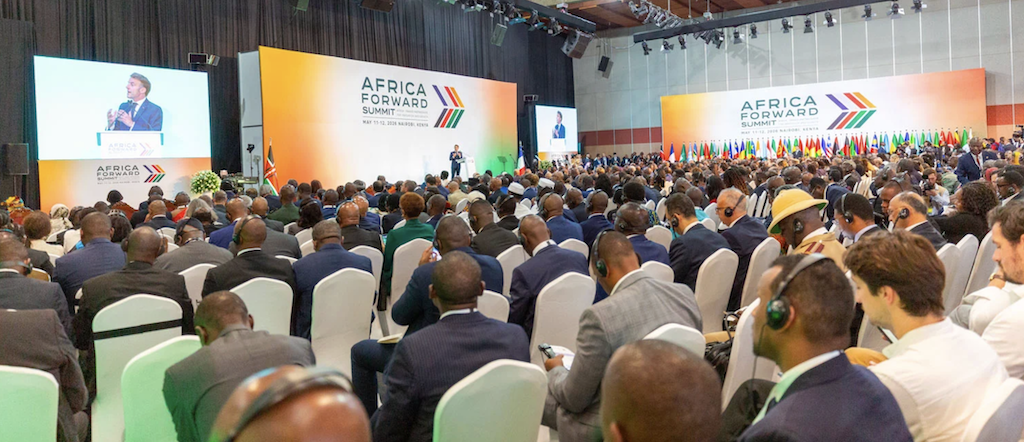
On May 11th and 12th 2026, Nairobi became the epicentre of one of the most important diplomatic and economic gatherings in recent African history. The inaugural Africa Forward Summit, formally titled ‘Africa-France Partnerships for Innovation and Growth,’ was co-hosted by Kenyan President William Ruto and French President Emmanuel Macron at the Kenyatta International Convention Centre (KICC) and the University of Nairobi.
With more than 30 African heads of state in attendance, alongside more than 2,500 global business leaders, investors, innovators, and development partners, the summit marked a deliberate step in restructuring how Africa engages with global capital and international partners.
Importantly, this was the first time France had co-chaired such a high-level summit with an English-speaking African nation, a dynamic with noteworthy symbolic significance. It showed a conscious widening of France’s engagement well outside its traditional Francophone sphere of influence, and recognition that the future of Africa-Europe economic relations should be anchored in wider, more equitable partnerships across the continent.
As the official summit framework noted, this new model consciously rejects ‘bloc mindsets, predation, and new imperialist tendencies,’ positioning itself instead on the ideals of co-creation, co-investment, and discernible impact. For investors watching the African continent, there were inferences to take note of.
It was a summit built for investment and not just dialogue
Something about the Africa Forward Summit distinguished it from earlier Africa-France gatherings. That is its design. While previous summits were often criticised for producing grand declarations with limited follow-through, the 2026 Nairobi summit was unequivocally designed around delivering bankable and implementable outcomes that could be scaled.
The agenda was organised across seven strategic thematic pillars of green industrialisation and the energy transition, reform of the international financial architecture, the blue economy, sustainable agriculture and food systems, artificial intelligence (AI) and digital technologies, resilient health systems, and peace and security.
These are, in fact, the self-same sectors where global capital is increasingly concentrating, and where Africa’s structural advantages, in resources, demographics, and geographic standing, are most pronounced. The summit’s Business Forum, held at the University of Nairobi, featured B2B matchmaking, CEO roundtables, investment announcements, and sector-focused workshops drawing more than 1,500 business leaders and investors from across Africa and France. In ways, this was a lot more than just a conversation about Africa’s potential; an active mobilisation of capital directed at it.
The $27 billion headline and what it promised
Perhaps the most noteworthy headline from the summit was President Macron’s announcement of 23 billion euros (approximately $27 billion) in investment commitments directed at the African continent. Of that total, 14 billion euros ($16.4 billion) is set to be mobilised from French private and public funds, while African partners are expected to contribute 9 billion euros ($10.5 billion).
By design, this structure framed the announcement as a co-investment arrangement, not quite an aid programme. Macron was open on this point, stating that the summit is about a ‘partnership of equals,’ and that African business leaders are equally expected to invest in France.
The commitments involved cover energy transition, agriculture, and artificial intelligence, and are projected to create 250,000 jobs across France and Africa. Some specific deals announced at the margins of the summit were also strategically important. Shipping and logistics group CMA CGM signed a 700 million euro agreement to expand and modernise the terminal at Kenya’s Port of Mombasa, a deal that strengthens East Africa’s connectivity to global trade routes.
Proparco, the private-sector arm of France’s Agence Francaise de Developpement (AFD), announced a 300 million euro facility with Ecobank to strengthen agricultural value chains, a 200 million euro cross-currency facility with the West African Development Bank (BOAD), and a 300 million euro partnership with the AXIAN Group targeting telecom connectivity and renewable energy expansion.
The summit’s outcomes are also expected to feed directly into France’s G7 presidency agenda in June 2026, giving African priorities, particularly around the reform of the global financial architecture, a clearer line of sight to the table of the world’s most powerful economies.
What the summit means for Africa’s investment landscape
The investment implications of the Africa Forward Summit can be viewed from different perspectives and go well past the bilateral France-Africa dimension.
Energy and Green Industrialisation: The summit produced substantial commitments on energy transition and green industrialisation, areas where the continent’s investment gap remains acute. Kenya and France signed bilateral agreements covering wind energy expansion and nuclear cooperation, while the general summit framework highlighted Africa’s strong potential as a producer and exporter of clean energy.
For investors in renewables, infrastructure, and industrial manufacturing, the summit reinforced the policy direction that African governments are actively pursuing in this space, and shows that international co-financing structures are now being put in place to support it.
Digital Economy and Artificial Intelligence: With AI and digital competitiveness identified as key pillars, the summit committed to investment in digital infrastructure, open AI partnerships, and the growth of start-ups and tech talent. France put its AI engagement with Africa as offering a ‘third way,’ an alternative to the models promoted by the United States and China, built on open frameworks and shared technological sovereignty.
A new science and engineering complex at the University of Nairobi, to be built with French support, was announced as part of this commitment. For investors in technology, fintech, and digital infrastructure, this points to an enhanced African tech investment thesis.
Agriculture and Food Systems: The Nairobi Declaration, adopted at the summit’s close, put agriculture prominently on the agenda. The leaders made a commitment to strengthening food security, promoting climate-resilient agricultural systems, supporting the Africa Fertilizer and Soil Health Action Plan 2024-2034, and increasing investment in agro-industrial parks and competitive agricultural value chains.
Public-private partnerships were identified as a primary vehicle for this investment. Given that agriculture employs the majority of Africa’s working population and remains critically underfinanced, this meant a significant opening for patient, long-term capital.
Infrastructure and Logistics: The CMA CGM deal at Mombasa and the modernisation of the Nairobi Commuter Rail system are indicators of a wider infrastructure push. Improved port capacity and urban connectivity are essential for the commercial viability of every other investment sector. As regional trade volumes grow, particularly under the African Continental Free Trade Area (AfCFTA), the value of logistics and transport infrastructure will only appreciate.
Health and Pharmaceuticals: The summit declaration made a strong commitment to resilient and people-centred healthcare systems, including strengthened local production of vaccines and medicines and continental capacity-building in health. This is an area where co-investment between European partners and African manufacturers has considerable potential, particularly as Africa works to reduce its reliance on imported pharmaceutical products.
A structural move from aid to investment
Perhaps the most important strategic point from the Africa Forward Summit is the one most easily overlooked in the headlines. France approved overseas aid spending of 3.5 billion euros in 2026, an 18% reduction from the previous year and a decline of more than 2 billion euros from 2024 levels.
Experts view this as reorientation. As Macron noted at the summit, France is “in Africa for the long haul,” but the operating model has changed. The era of aid-led engagement is giving way to an era of investment-led partnership. In simple words, private, commercial, and strategic capital is now the primary mechanism of France’s Africa policy.
For the continent’s investment community, this has some implications, in that the pipeline of commercially structured, private-sector-driven transactions in Africa could grow materially. The political and diplomatic architecture supporting risk mitigation, regulatory reform, and financial co-investment is now being actively constructed. And investors who understand this have an opportunity to situate themselves ahead of capital flows that could intensify over the next several years.
But a few challenges must not be overlooked
While the Africa Forward Summit is a significant development, a clear-eyed assessment requires acknowledging that there are still some challenges. Africa has hosted many high-profile summits over the years, and the gap between declaration and implementation has always been the biggest hurdle. To work, the commitments made in Nairobi need to be followed by clear accountability frameworks, solid project pipelines, and sustained political will on both sides.
African leaders, including Kenya’s President Ruto, also used the summit as an opportunity to push for reforms in global risk pricing and the international financial architecture, a realization that the continent continues to face some unfair borrowing costs that constrain the ability to finance development on competitive terms. Until these systemic imbalances are addressed, even the most well-intentioned investment pledges will be partially offset by the cost of capital disadvantage. The summit’s outcomes feeding into the G7 agenda in June are, therefore, worth monitoring closely.
There are also valid questions around technology transfer, the real openness of new partnerships to African business leadership, and whether the continental benefits of these investments will be widely distributed or concentrated in a small number of gateway economies.
Where do serious investors go from here?
Of course, summit declarations are just a starting point, and not an endpoint. The Africa Forward Summit has been useful; putting capital commitments, partnership structures, and sector-specific deals on the record, with named institutions, records, and a political timeline attached, which is more than most Africa-focused summits have historically produced.
But converting that into returns, whether in energy, agriculture, logistics, digital infrastructure, or health, requires investors to make decisions based on country-level intelligence, sector veracities, and relationship networks that are not put together from a conference room in Nairobi.
This is what AMENA AFRICA was built for. Our offices in Nairobi, Lagos, Accra, Cape Town, and Port Louis give us the benefit of being at an operational link between international investment objectives and African market conditions.
When clients, for instance, seek the markets best positioned to absorb capital in the energy transition, or which agricultural value chains in West Africa are investment-ready, or how to structure a compliant and commercially viable market entry in Africa’s digital economy, such inquiries make up what we do.
The Africa Forward Summit has reinforced an idea that we have always maintained: that the investment case for Africa is structural, and not quite episodic. Summits come and go, commodity cycles turn, and geopolitical partnerships change, but the continent’s population growth, resource base, expanding intra-African trade under AfCFTA, and enhanced institutional frameworks are long-term investment narratives. What changes with moments like this one is the pace at which capital structures are put in place to support it.
So, are you keen on transitioning from just awareness to action on the African continent? Or do you need a partner knowledgeable in interpreting the summit’s commitments into specific, executable market strategies? AMENA AFRICA is always ready to help you do that.
Browse more content!
- All
- Africa Affairs
- Growth Strategy
- Market Entry
- Market Research
- Payroll Service

Kenya’s packaging industry in 2026 and beyond: Opportunities for international manufacturers and investors

Registering a company vs. Employer of Record services in Africa. Which one makes more sense?

Africa strategy: What to look out for and how to develop one

Navigating Nigeria’s automotive policy and the race to build a local EV and assembly ecosystem