The Elephant Not in the Room: How Leaders Are Responding to America’s Absence from the G20
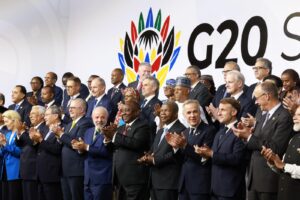
The November 22–23, 2025, Group of Twenty (G20) summit in Johannesburg was marked by quite an unusual moment in international diplomacy. For the first time since the forum was established in 1999, the United States did not send any official delegation to the leaders’ summit. The complete boycott means even Vice President J.D. Vance, originally expected to represent Washington, did not attend.
This absence, as announced through President Donald Trump’s Truth Social posts on November 7th, was quite a departure from more than two decades of American participation in multilateral economic governance. In ways, it casts the spotlight on the Trump administration’s general retreat from international institutions.
More than just a diplomatic snub, the decision to abstain from a forum it will chair next year (as the incoming G20 president) presents a challenge to the architecture of global cooperation that emerged from the financial crises of the late 1990s. The Trump administration’s move has left international observers wrestling with questions about the future of multilateralism, the credibility of global economic coordination, and the strategic calculations that drove the White House to make such a dramatic turnaround.

The historical context of the G20
To understand the impact of this move, one needs to first appreciate what the G20 is all about. The forum was established as a response to the torrent of financial crises that threatened global stability through the late 1990s. Remember the Mexican peso crisis, the 1997 Asian financial crisis, the 1998 Russian financial crisis, and the near collapse of the Long-Term Capital Management (LTCM)? Finance ministers and central bank governors from the world’s largest industrialized and emerging economies created an informal mechanism for dialogue on matters of international economic and financial stability.
For nearly a decade, the G20 primarily functioned at the finance minister level. However, the 2008 global financial crisis made it a heads-of-state and government forum, with the realization that it featured the representation needed to address challenges that went outside of the traditional G7 discussions.
From then onwards, American participation has been seen as crucial for legitimacy and consensus-building. The United States, as the world’s largest economy, shaped discussions on debt restructuring, pandemic response, climate action, and economic coordination. Even when political disagreements prevailed among members, the American seat remained occupied. That is, until now.
The Trump administration's rationale
The Trump administration’s justification for its boycott of the forum is based ostensibly on allegations of human rights abuses against white farmers and Afrikaners in South Africa. Trump has maintained that the South African descendants of Dutch, French, and German settlers face systematic violence and land confiscation, describing the situation as violations warranting international condemnation. But how factual is this? In May 2025, when President Cyril Ramaphosa visited the White House to lobby Trump to attend the summit, the U.S. president presented videos and articles asserting widespread persecution, stating that “a white farmer genocide is taking place in South Africa.”
When Ramaphosa explained that such statements represented a minority fringe and were not government policy in South Africa’s multiparty democracy, the explanation was rejected, and subsequently unilateral measures were launched, including accepting white South Africans as refugees in an exceptional program, cutting U.S. aid to South Africa, and even suggesting that the country be debarred from the G20 entirely.
However, these allegations have been widely disputed. Independent fact-checkers, human rights organizations, and South African officials have refuted the characterizations as exaggerated or factually inaccurate. The actual causes of farm violence in South Africa are complex, involving property crime, poverty, and agricultural disputes; hardly about systematic racial persecution. Nonetheless, experts suggest that Trump’s public focus on these claims had domestic political undertones; to appeal to the white conservatives as a defender of persecuted white farmers during a period of global demographic and political change.
An ideological framework of unilateralism?
Trump’s decision to boycott the G20 fits into his larger ‘America First’ foreign policy doctrine, which basically rejects multilateralism in favor of bilateral relations and nationalist priorities. During his first administration, he withdrew from the Trans-Pacific Partnership, the Paris Climate Accord, UNESCO, and other multilateral frameworks, justifying these moves based on the grounds that international institutions disadvantage American interests.
His second administration appears to be pursuing a more aggressive version of this strategy, with the Trump administration’s officials skipping earlier G20 meetings hosted by South Africa in February and July 2025. The pattern of disengagement was just starting as perhaps a deliberate strategy of disruption rather than just a scheduling conflict.
Experts note that the boycott shows a deeper ideological opposition to multilateral institutions, which the Trump administration views with skepticism. The G20 itself emphasizes inclusive growth, climate action, sustainable development, and reformed global governance that raises the voice of the Global South, but has become incompatible with the Trump administration’s nationalist priorities.
South Africa’s presidency theme of ‘Solidarity, Equality, Sustainability’ and its G20 working agenda, focused on inclusive economic growth, food security, and artificial intelligence (AI) for development, stands at odds with Trump’s zero-sum conception of international relations.
Global reactions of disappointment, resilience, and strategic recalculation
The international response to America’s absence has brought to light fissures in the global order. South African President Ramaphosa framed the boycott as self-defeating, saying it is “their (U.S’) loss,” and noted that the United States is giving up the very important role that it should be playing as the biggest economy in the world; a rejoinder that shows concern that America’s withdrawal undermines consensus-building on important global issues.
Several European leaders attend the summit, including those from Germany, France, and Italy. European Commission President Ursula Von der Leyen represents the EU Bloc. Some observers suggest that Europe may use the American absence to strengthen its own voice and articulate alternative visions for global governance, as well as show commitment to multilateralism despite America’s seeming disengagement.
While Prime Minister Narendra Modi of India has not commented on the boycott, all indications point to India’s commitment to participating. India, which chaired the G20 in 2023 and championed inclusive development models, views South Africa’s presidency as an extension of the Global South’s growing influence in global governance. Modi’s attendance and vocal support for the summit show that emerging economies view the G20 as increasingly key to their interests.
Meanwhile, Brazil’s government, which hosted last year’s G20 summit in Rio de Janeiro and will coordinate with South Africa on transition issues, has expressed disappointment but willingness to proceed. The African Union, represented by Chairperson Mahmoud Ali Youssouf, expressed concern about the American boycott but emphasized African determination, noting, “I think the African continent has decided to take its destiny into its hands and we are definitely working to increase the self-reliance.”
What are the implications for global cooperation and consensus?
The implications of the U.S. absence are much more than just symbolic. The G20 operates on consensus, and the withdrawal of the world’s largest economy greatly complicates negotiations on key issues, including climate finance, global tax reform, development assistance, and economic regulation. Historically, the American signature on G20 communiqués has provided legitimacy and enforceability to all agreed-upon frameworks. How will that work in its absence?
Moreover, the incoming American G20 presidency creates awkward logistics. South Africa will be required to hand over the presidency to the U.S, whose leader has suggested he may not attend or participate in this year’s event. This, perhaps, raises questions on how consensus can be achieved when the incoming chair is already hostile to the institution itself. South Africa, according to President Ramaphosa, will, however, hand the G20 over to the US ’empty chair.’
Also, could the boycott accelerate the fragmentation of the international order? Emerging economies are potentially moving toward alternative forums like BRICS (Brazil, Russia, India, China, South Africa), which excludes the U.S and offers more autonomy to Global South countries. Could this realignment be accelerated by the signal that the Trump administration’s boycott sends about American withdrawal from inclusive multilateral structures?
Are there implications for African investment markets?
America’s absence from the Johannesburg G20 Summit brings challenges and opportunities for Africa’s investment markets. On the immediate front, it heralds considerable headwinds. The United States is traditionally a major source of foreign direct investment and development financing. American backing at multilateral forums has been essential in advocating for debt relief, fairer borrowing terms, and infrastructure development across Africa.
The withdrawal of U.S. participation undermines consensus-building on priorities like reducing the high cost of capital, a structural hurdle that makes African borrowing significantly more expensive than other emerging markets. Moreover, South Africa specifically faces pressure, as the country negotiates a tariff arrangement with the Trump administration following an August 30% import duty on its goods, the highest rate in sub-Saharan Africa.
Without coordinated G20 support and American goodwill, African economies may struggle to implement debt restructuring frameworks, climate finance mechanisms, and trade agreements that South Africa sought to champion through its presidency priorities. America’s absence also threatens the continuity of initiatives like the G20 Compact with Africa and undermines efforts to reform the international financial architecture that disadvantages developing economies.
But the boycott also creates strategic opportunities for Africa to reshape its investment and partnership dynamics. With the U.S seemingly stepping back from multilateral engagement, African policymakers and the G20 Bloc itself seem energized to accelerate new negotiations on alternative ways for ties with BRICS members, which would attract non-Western investment, and leverage the continent’s wealth.
The AU leadership also emphasized Africa’s determination to take its destiny into its own hands, a pointer to renewed vigor towards self-reliance, domestic resource mobilization, and intra-African trade through the African Continental Free Trade Area (AfCFTA). Such reorientation creates fertile ground for investment.
Keen on knowing more on navigating Africa’s evolving landscape even after the G20 Summit? Or all emerging investment possibilities the continent has to offer? AMENA AFRICA offer essential on-the-ground expertise, analysis, insights and market intelligence to guide you through the continent’s increasingly opportunity-rich landscape.
Browse more content!
- All
- Africa Affairs
- Growth Strategy
- Market Entry

Building local partnerships for sustainable business growth in Nigeria
The Elephant Not in the Room: How Leaders Are Responding to America’s Absence from the G20

The role of AI in shaping market-entry strategies for African businesses
Navigating Regulatory and Operational Challenges in African Markets